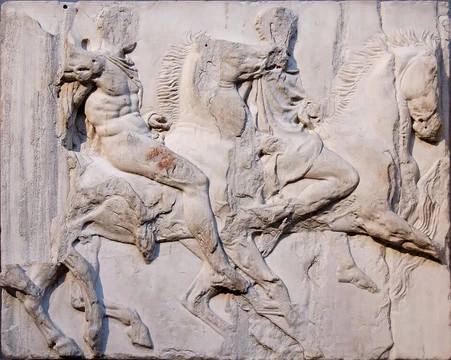
Relief
Sculptural method where forms remain attached to a solid background.

Wikipedia / Wikimedia Commons
Relief is a sculptural technique where the carved or modeled forms stay attached to a solid background made of the same material. The word comes from the Latin *relevare*, meaning "to raise" or "lift back." The goal is to make it look as though the material has been lifted above the background surface. When carving into wood or stone, the background is actually cut away, leaving the untouched areas appearing higher; this process of chiseling away the field can be time-consuming. However, relief sculpture avoids the need to shape the back of a subject, and it is less fragile and more securely attached than a freestanding sculpture—especially a standing figure, where the ankles are a weak point in stone. In materials like metal, clay, plaster, stucco, ceramics, or papier-mâché, the form can simply be added onto the background. Monumental bronze reliefs are made through casting.
The degree of projection from the background varies, and Italian or French terms are sometimes used in English for these distinctions. The full range includes high relief (where more than half the depth is shown and undercut areas may appear), mid-relief, low relief, and shallow relief (where the plane is only slightly lower than the sculpted elements). There is also sunk relief, mostly found in Ancient Egypt. The clearest and most important distinction is between high and low relief, and these two are typically the only ones used in discussing most works. Definitions of these terms are somewhat flexible, and many works combine multiple types, sometimes within a single figure; some writers therefore avoid all distinctions. The opposite of relief is counter-relief, intaglio, or cavo-rilievo, where the form is cut into the background rather than rising from it—this is very rare in monumental sculpture. Hyphens may or may not be used in these terms, though "sunk relief" rarely has one, while "bas-relief" and "counter-relief" usually do. Works are described as "in relief," and the piece itself is called "a relief."
Reliefs appear worldwide on building walls and in smaller settings, and a series of panels can tell an extended story. Relief is better suited than freestanding sculpture for depicting complex scenes with many figures and active poses, such as battles. Most ancient architectural reliefs were originally painted, which helped define forms in low relief. While reliefs often show f
- field
- Sculpture
- known_for
- Sculptural method where forms remain attached to a background
- types
- High relief, low relief, mid-relief, shallow-relief, sunk relief, counter-relief
Lore & Background
Relief sculpture involves carving into a flat surface of wood or stone by lowering the field, leaving unsculpted areas seeming higher. This approach requires chiselling away of the background, which can be time-intensive. However, a relief saves forming the rear of a subject and is less fragile and more securely fixed than a sculpture in the round, especially one of a standing figure where the ankles are a potential weak point, particularly in stone. In other materials such as metal, clay, plaster stucco, ceramics or papier-mâché, the form can be simply added to or raised up from the background. Monumental bronze reliefs are made by casting.
Reader's Guide
Relief sculpture offers different degrees of projection from the field, including high relief (where more than 50% of the depth is shown and there may be undercut areas), mid-relief, low relief, and shallow-relief (where the plane is only very slightly lower than the sculpted elements). Sunk relief was mainly restricted to Ancient Egypt. The distinction between high relief and low relief is the clearest and most important, and these two are generally the only terms used to discuss most work. The definition of these terms is somewhat variable, and many works combine areas in more than one of them. Relief is more suitable for depicting complicated subjects with many figures and very active poses, such as battles, than free-standing sculpture in the round. Most ancient architectural reliefs were originally painted, which helped to define forms in low relief. Rock reliefs are those carved into solid rock in the open air, found in many cultures, particularly those of the Ancient Near East and Buddhist countries.
Did You Know?
- The term relief comes from the Latin verb relevare, meaning 'to raise'.
- In low relief, the relative depth of elements shown is completely distorted when seen from the side.
- The Ishtar Gate of Babylon has low reliefs of large animals formed from moulded bricks, glazed in colour.
- Shallow-relief, in Italian rilievo stiacciato, was effectively invented and perfected by the Italian Renaissance sculptor Donatello.
Frequently Asked Questions
What is Relief in sculpture?
Relief is a sculptural technique in which the carved or modeled figures remain attached to a flat background made of the same material. Instead of standing fully in the round, the forms appear to project outward from that solid surface.
Where does the name "Relief" come from?
The term traces back to the Latin word relevare, which carries the sense of raising or lifting something upward. In practice, the sculptor aims to create the visual impression that the material has been lifted above the background plane.
What are the main types of Relief?
Relief is generally divided into high relief, low relief, mid-relief, shallow-relief, sunk relief, and counter-relief. The distinction comes down to how far the figures project from, or recede into, the background surface.
How is a relief sculpture actually made?
When working in stone or wood, the artist chisels away the background field so the untouched areas appear raised above the carved-out sections. This process of cutting back the field can be quite time-consuming, but it spares the sculptor from having to shape the rear of the subject.
Why is Relief considered more practical than free-standing sculpture?
Because the figures stay anchored to a solid backing, relief pieces are inherently more structurally secure and far less prone to breakage. They also save the artist the labor of modeling the back of a subject, which would be required in a fully round sculpture.
More in Sculptures And Statues 1-24
Spotted an error? Know more?
This is a living reference — every entry is fact-audited, and reader corrections feed straight into our audit queue. Suggest an edit · See this site's audit record